
AI Trends for Non Profits: Transforming Client Services with Speech-to-Text

AI Trends for Non Profits
AI is increasingly becoming a focus for Non for Profits (NFP) to adopt as part of their three-year digital and operations strategies. Like many organisations, Non for Profits will set out to adopt AI, but become overwhelmed on where to start.
This is rightly so.
The amount of technology solutions available under the umbrella of AI continues to grow everyday and businesses can struggle to understand which might be the best solution for them.
Non-Profits present as an interesting industry, as while they often rely on donations for funding, their industries can span across health care, agriculture, social services and many more.
In this article, we will describe some common themes and use cases that we've seen amongst Non-Profits, in the hope it will inspire some ways you can shape your own digital strategy.
Non-Profit organizations across various sectors from healthcare to social services are discovering practical AI applications that deliver measurable improvements in efficiency and service quality.
Transcribing Audio for Insights
In one project for a Non Profit who was dealing with marginalised people such as those struggling with addiction and homelessness, we helped develop a tool to manage their case worker's interactions on the frontline.
The challenge was that case workers would be meeting with many of their clients throughout the day on the road and then would have to come back to their desk to transcribe their notes into a Customer Relationship Management tool (CRM). Because they had seen so many clients throughout the day, issues arose with the quality of the data as the case workers often had trouble remembering exactly what was spoken about with their clients.
Even if they had managed to take notes during the interaction, the case workers still felt that their account was not an accurate representation of what had been discussed with their client due to the time elapsed between interacting with their client and recording notes in the CRM.
Case workers also spent a lot of time updating the CRM with information from client interactions and wanted a solution to be able to increase the reliability of the information captured as well as reducing the time spent inputting the information.
The Challenge: Case workers were spending excessive time on manual data entry while struggling to maintain accurate records of client interactions, impacting both efficiency and service quality.
Process Review
Upon reviewing the key information needed for the CRM, we identified that case workers need to capture the following information from their client:
- Whether the client had any interaction with their family during that period
- Had they been complying with any medications or other health directions
- Did they have regular contact with their case worker
- Had they engaged in any recreational activities that would lift their spirits
- Did they have issues with alcohol and or drugs
- If they did, were they seeking treatment
Proposed Solution
After the review, we identified that the case workers would be able to record the client interactions on their phone, given that the client provided consent to be recorded. After receiving the recording, we would be able to transcribe the audio into text and then pull out the key information that was identified in the Process Review stage. After that, we would be able to automatically push that key information to their CRM.
Smart Automation: By combining speech-to-text technology with AI-powered data extraction, we created a solution that captures client interactions accurately while dramatically reducing manual work.
Solution Architecture
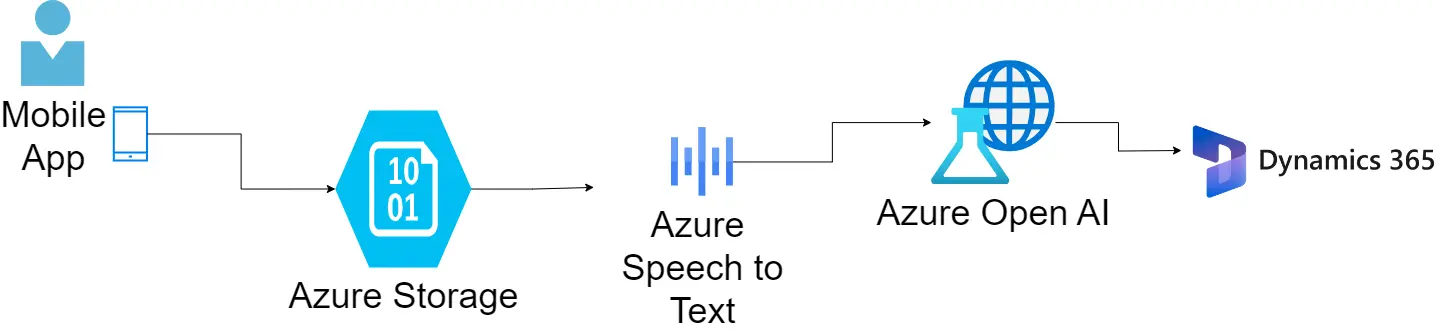
You can see a diagram of the architecture we implemented below.
We created a mobile web application for the case workers to record the client interaction with. Once the interaction was finished, the recording would then push to an Azure Storage Account which would then trigger the Azure Speech-to-Text service to transcribe the audio into text.
Once the text was transcribed, it would be saved to a text file, which triggered another piece of code logic to send the transcribed text to the Azure Open AI service, which used a custom prompt to extract the key information needed that we gathered in the Process Review. Once that information was extracted, we then made an API call to Dataverse, which is the database for Dynamics CRM and the data was successfully pushed and updated to the correct CRM record.
Key Technology Components
1. Mobile Web Application
- User-friendly interface for case workers
- Secure audio recording capabilities
- Consent management features
2. Azure Storage Account
- Reliable cloud storage for audio files
- Automated trigger system for processing
3. Azure Speech-to-Text
- High-accuracy transcription
- Support for various accents and speaking styles
4. Azure OpenAI Service
- Custom prompts for data extraction
- Intelligent parsing of unstructured conversation data
5. Dataverse Integration
- Seamless CRM updates
- Automated record matching and updating
Results
After checking back in with the client a month later, case workers reported saving over 10 hours per week on manual information entry and also had much more reliable accounts of interactions with their clients.
Measurable Impact:
- 10+ hours saved per case worker per week
- Significantly improved data accuracy
- Better client service quality
- Reduced administrative burden
Getting Started with AI in Your Non-Profit
If you're a Non-Profit organization looking to implement AI solutions, consider these steps:
- Identify Pain Points: Start by mapping out the most time-consuming manual processes in your organization
- Review Data Needs: Understand what information is critical for your operations
- Start Small: Begin with a pilot project in one department or team
- Measure Success: Track time savings and quality improvements
- Scale Gradually: Expand successful implementations across your organization
Interested in implementing AI solutions for your Non-Profit? Contact us to discuss how we can help streamline your operations and improve service delivery.
Conclusion
AI doesn't have to be overwhelming for Non-Profit organizations. By focusing on specific use cases that address real pain points—like our case management solution—you can achieve significant improvements in efficiency and service quality. The key is to start with a clear understanding of your needs and build solutions that directly address them.
As AI technology continues to evolve, Non-Profits have an unprecedented opportunity to do more with limited resources, ultimately serving their communities better and fulfilling their missions more effectively.