
Noticed Your Psychology Google Ads Aren't Performing? Here's Why and How to Fix It
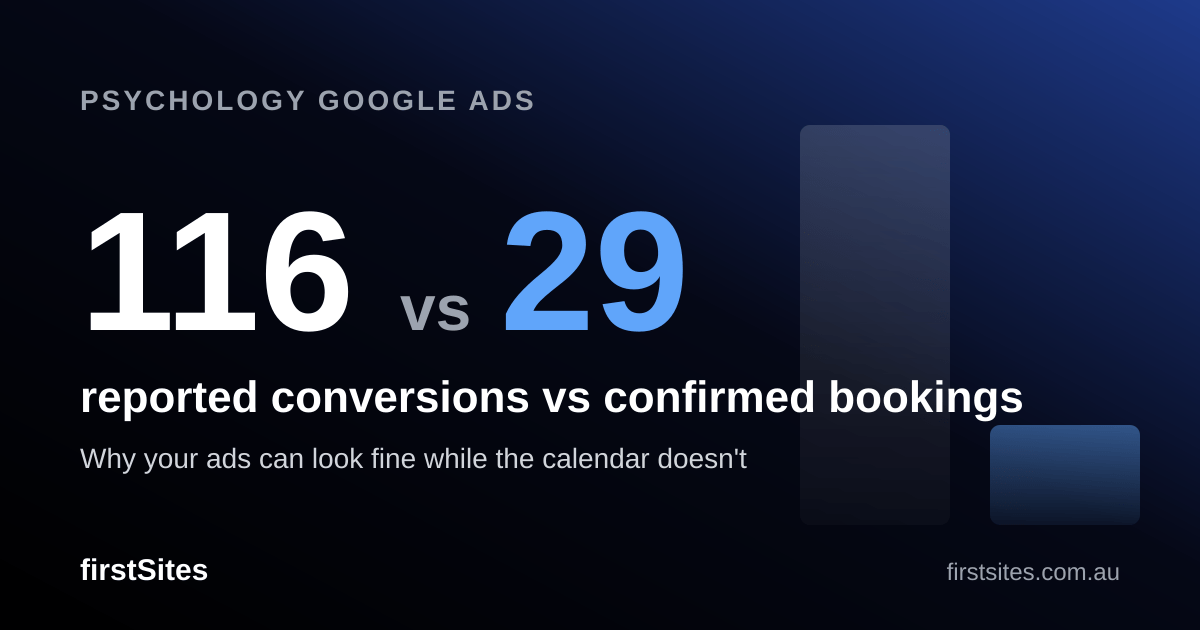
We've managed Google Ads for more than 15 psychology practices. In one Sydney account, Google reported 116 conversions in the 60 days to 21 June, but only 29 were confirmed bookings. Within six months, the price of a click on “psychologist” in the same account roughly tripled. Here's what sat behind it and how to fix it.
The short version: you can't outbid the national brands. Count real bookings, own your own name organically, and go specific instead of generic.
The same keyword now costs three times as much
Take the broad keyword “psychologist”. Across five reports its Quality Score sat at 3 out of 10 and its click-through rate barely moved. Its price per click did this:
| Report window | Average cost per click | Click-through rate | Quality Score |
|---|---|---|---|
| 90 days to about April | $2.37 | 5.9% | 3 |
| 60 days to about June | $1.79 | 4.8% | 3 |
| 30 days to 15 Sep | $5.38 | 4.8% | 3 |
| 30 days to 8 Oct | $5.38 | 4.3% | 3 |
| 30 days to 14 Oct | $5.47 | 4.4% | 3 |
The last two windows overlap, so read them as one picture.
Searchers kept clicking at about the same rate, and Google's ratings for the ad and the page didn't change. If search behaviour had shifted, click-through rate would have moved with it. It didn't. What moved was the price.
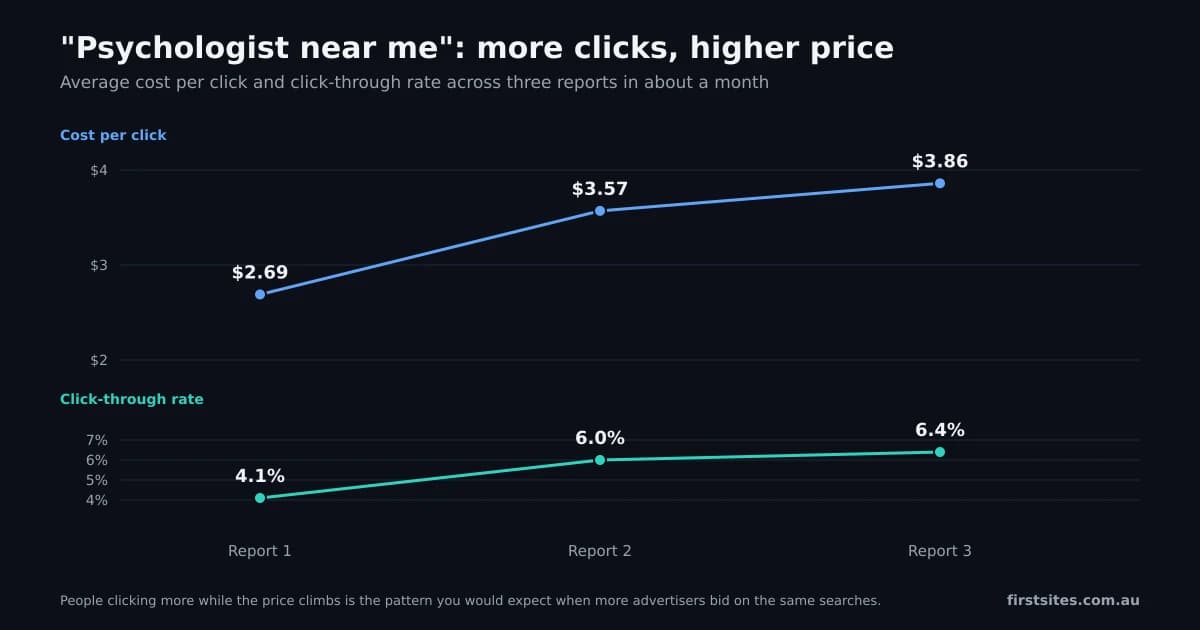
It's the same story on other terms. “Psychologist sydney” went from $2.84 to between $6.80 and $6.94, though the earlier figure comes from only 155 impressions. And “psychologist near me” climbed from $2.69 to $3.57 to $3.86 across three reports in about a month, while its click-through rate rose from 4.1% to 6.0% to 6.4%. People clicking more while the price climbs is what you'd expect when more advertisers bid on the same searches.
Two things changed at once
In the same stretch, the market got more crowded and the account's bidding strategy moved from manual to Target CPA once it had built up conversion history. The standard reports can't cleanly separate the two. Auction Insights, below, shows the competition side.
The market moved too
The early numbers were also unusually cheap. Industry benchmarks put psychologist cost per click at roughly $4 to $10 . At $1.79 (60 days to about June) this account was paying well under the market rate. At $5.38 (30 days to 15 Sep) it was paying a normal price. Part of the “tripling” is the account arriving where the market already was.
US data points the same way. A 2026 analysis of LocaliQ benchmarks reports mental health cost per click up more than 42% year over year, the largest rise among 16 healthcare categories, at an average of USD 4.22. It's US data, so treat it as direction, not a local benchmark.
Who's bidding against you now
Mental health is a category where well-funded brands spend heavily on Google, and a single practice bidding on “psychologist” is in the same auction as all of them. In July I noticed large national and telehealth providers showing up in the same auctions, and I raised lifting the budget with the client.
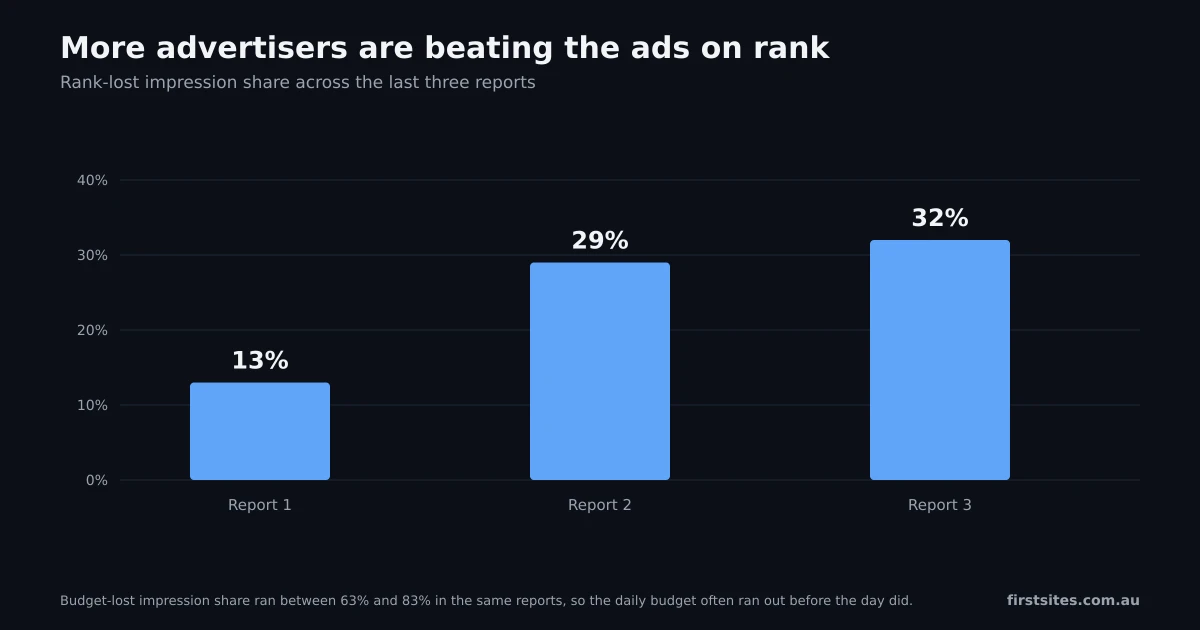
The account shows the signs. Rank-lost impression share, the share of auctions where the ads were beaten on ad rank, climbed from 13% to 29% to 32% across the last three reports. Budget-lost impression share ran between 63% and 83%, which means that at these prices the daily budget was running out before the day did.
Auction Insights is the report most practices never open. It lists every advertiser that appeared in the same auctions as you. I pulled it for two windows: 21 June to 20 July, the earliest data available, and 22 September to 21 October.
| Advertiser | Impression share | Overlap rate |
|---|---|---|
| betterhelp.com | 16.4% to 30.1% | 21.7% to 34.5% |
| updoc.com.au | under 10% to 17.9% | 7.3% to 21.4% |
| psychologytoday.com | 13.3% to 11.5% | 19.5% to 14.7% |
Each cell shows the June-July figure, then the September-October figure. Overlap rate is how often the competitor's ad showed alongside the practice's. The practice itself sat under 10% impression share in both windows.
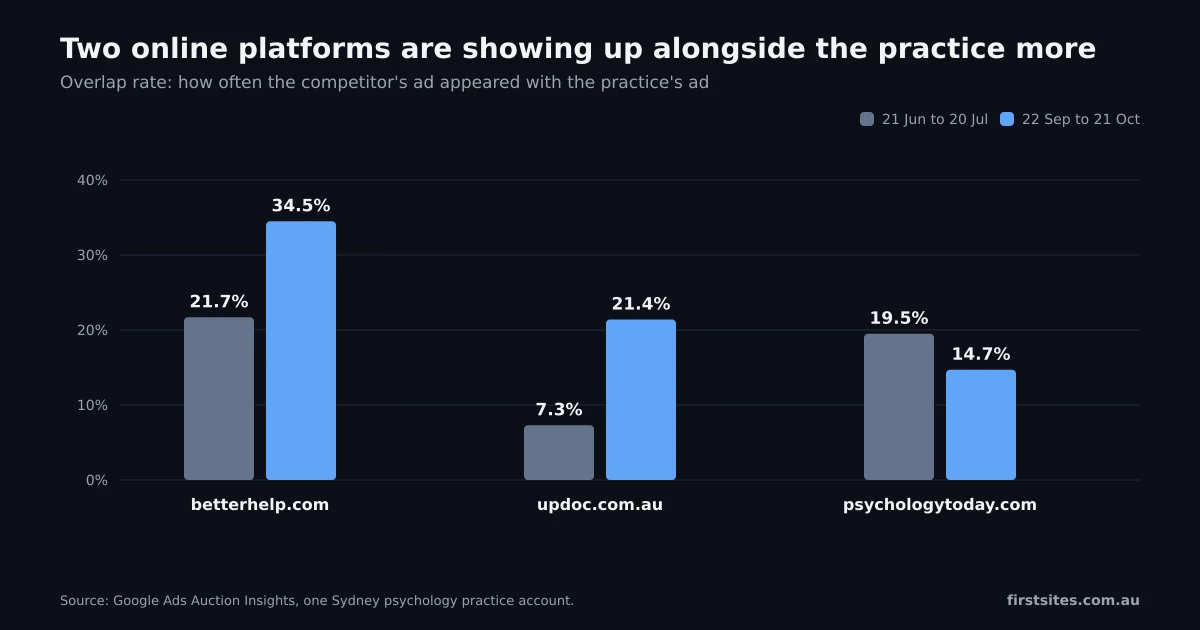
The growth is concentrated in two online platforms. BetterHelp's impression share nearly doubled. In the later window it appeared in about a third of the auctions the practice entered, and when both ads showed, it ranked above the practice 66% of the time. UpDoc's overlap with the practice tripled. The directory barely moved. The rest of the list was an insurer, a couple of smaller platforms and several clinics, each under 10% impression share.
Over the same period the practice's own ad reached the top of the page more often, 66.4% of impressions rising to 73.9%, while the very first slot held roughly steady at 25.1% then 22.0%. That is consistent with automated bidding paying for better positions against stronger bidders.
What does this explain? The jump in weekly cost per click from about $1.57 in May to $4.15 in the week of 8 June comes before Auction Insights has any data, and the big step coincides with the move to automated bidding described above. The climb since, from about $4 in the week of 8 June to above $5 in the 30 days to 14 October, is consistent with BetterHelp and UpDoc taking a bigger share. Weekly cost per click on non-brand keywords would confirm the split.
Your report may be flattering you
One of the most common problems we find in psychologist Google Ads accounts before we take over is that the account counts the wrong thing as a conversion.
Here's what that looked like in one account. In the 60 days to 21 June, Google reported 116 conversions on about $3,000 of spend, which works out at about $26 each. But 87 of those 116 were clicks on the “Book a session” link, and only 29 were confirmed bookings. The booking system (Halaxy) sits on a separate site, so the easiest thing for the ad account to record was the click that left the website, not the booking that followed.
| What Google counted | Conversions | Cost per conversion |
|---|---|---|
| Everything, including link clicks | 116 | about $26 |
| Confirmed bookings only | 29 | about $104 |
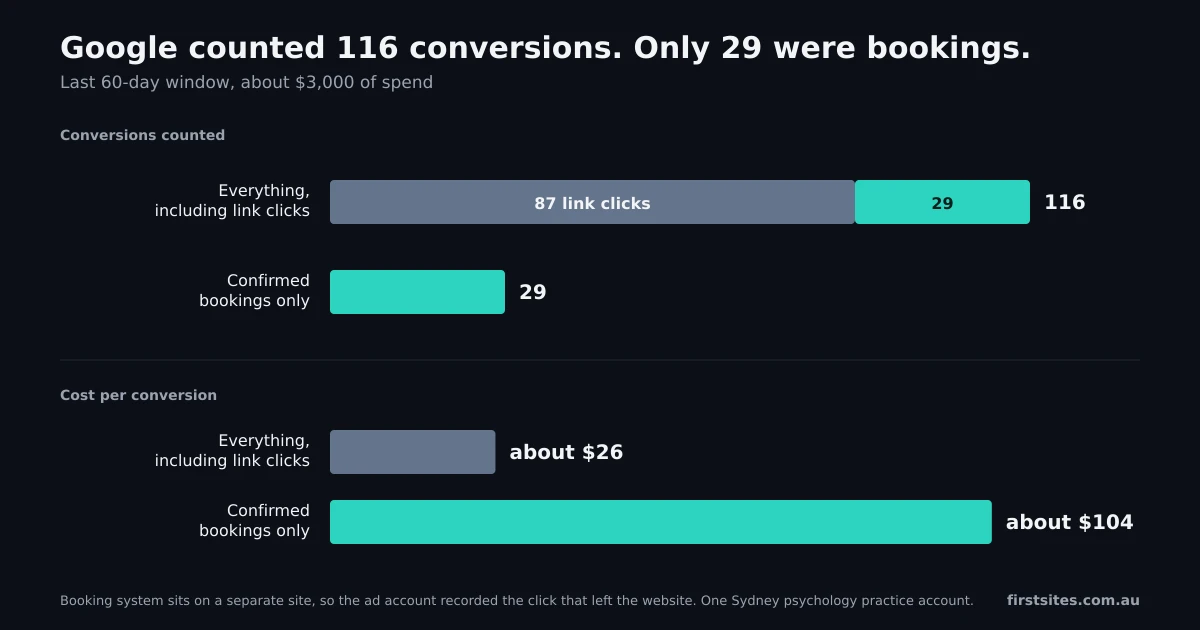
This matters most in a crowded auction, for two reasons. Automated bidding optimises toward whatever you call a conversion, so if a button click counts, Google spends your money finding more button clickers rather than more clients. And when each click costs $5 instead of $2, every wasted click hurts more.
How the booking is counted now
Because Halaxy is a separate site, the Google tag on the practice website can't see what happens after the click. We use a Google tag container to capture the confirmed appointment event in the booking flow and send that to Google Ads as the conversion. The link click no longer counts as a conversion. The conversion fires only on a confirmed booking.
A related trap: conversion value is often a flat placeholder rather than real revenue. Here it's $175, so the return on ad spend figure is the booking count times $175.
Your landing page makes every click dearer
Quality Score is Google's estimate of how well your keyword, ad and page match what the searcher wants, and it feeds into what you pay per click. In this account the impression-weighted score was 2.0 in three separate reports spread across four months.
The breakdown points at one culprit. By mid-October all 7 scored keywords had a below-average landing page experience, up from 4 of 8 in the earlier export. Expected click-through rate was below average on 5 of 7. “Best psychologist sydney” and “treatment for anxiety” scored 1 out of 10 on all three components. The ad copy, meanwhile, earns average or better relevance almost everywhere, so the limit is the page, not the ads.
In an auction where better-funded advertisers push the price up, a weak page means you pay a premium on every click. It's also the one lever no competitor can take from you.
If you want to see how we approach this, our psychologist Google Ads service page covers the setup.
The fixes: own your name, then go specific
Rank for your own name, then stop paying for it
This is where SEO and ads meet, and where this account got its biggest budget win.
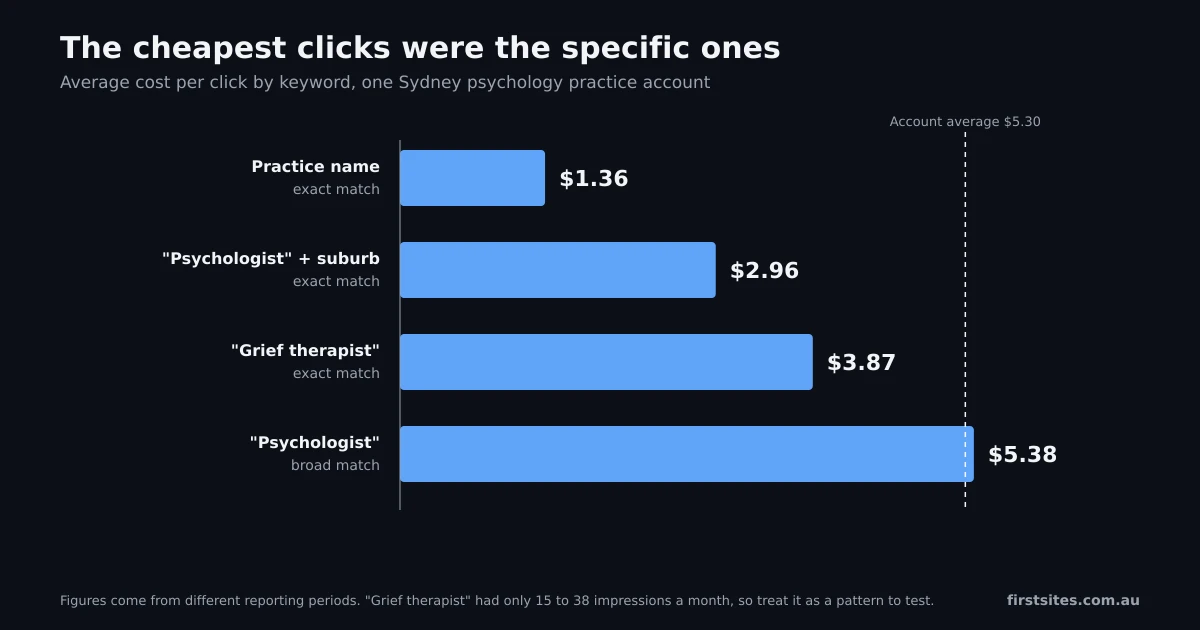
The cheapest clicks in the account were the ones on the practice's own name. The exact-match keyword for the practice name had a 41.7% click-through rate at $1.36 a click. The practitioner's own name ran at 27% to 30% with a Quality Score of 9. The exact keyword for “psychologist” plus the suburb cost $2.96 a click. Compare that with $5.38 or more on the generic keyword. In the 60-day export, brand searches were about 5% of clicks and roughly half of the conversions Google counted, though that count included link clicks.
They were also searches the practice already won for free. SEO had the site ranking first on Google for its own name and for its suburb, so every paid click on those terms was a click the practice would have received anyway. When I looked at who was clicking, about five clicks a week came from existing clients, and some of those cost as much as $7 because the same searches triggered the suburb keyword too.
So I paused brand and suburb bidding and pointed the budget at people who didn't know the practice yet. As competition pushes the price of a new-client click up, the value of every search you own organically goes up with it.
One rule applies. Search your own name in a private window first. If you rank first and nobody else is bidding on it, pausing is safe. If a competitor or directory appears above you, fixing that is worth doing before you spend more on ads.
Go specific, not generic
I went through the keyword data looking for any sign that people were searching differently. There wasn't one. There were about four to five unique search terms per 100 clicks in every period, and no new type of query was taking over. What changed was which keywords earned their keep:
- Broad “psychologist” stopped paying. It ran at $15 to $32 per conversion in earlier exports, though those figures include link clicks. In each of the last two reports it spent about $1,000 for 2 conversions. I paused that test keyword on 8 October.
- Niche terms held up. “Grief therapist” (exact match) gets only 15 to 38 impressions a month, but it converted in two of the periods at $3.87 a click, well under the account's $5.33 average in the 15 Sep to 14 Oct window. The counts are tiny, so treat it as a pattern to test, not a result.
- Broad match reads intent loosely. Among the search terms were queries that looked like someone hunting for a book or venting, not someone ready to book a psychologist. That is the cost of letting Google guess.
In a crowded auction the head term “psychologist” is where the big spenders hold the high ground. The searches that earned their keep were specific: a particular need, a particular person, a particular place.
Where the account stands now
With conversions tracked on confirmed bookings and the budget pointed at new clients, this is where the account stands. The practice's calendar is still full, which is why the account can afford to be judged on quality of bookings, not volume.
Here is the account across three measured windows. Clicks per booking is clicks divided by bookings in the same window.
| Window | Clicks | Bookings in window | Average CPC | Clicks per booking | Cost per booking |
|---|---|---|---|---|---|
| 60 days to 21 Jun | 1,583 | 29 | $1.91 | about 55 | about $104 |
| 15 Aug to 14 Sep | 305 | 11.2 | $5.52 | about 27 | about $151 |
| 15 Sep to 14 Oct | 294 | 7.0 | $5.33 | about 42 | about $224 |
How to read these numbers: this is one account with small counts (7 to 29 bookings per window), so read the figures as a range, not a precise result. Bookings are fractional because Google splits credit across touchpoints. The newest window is provisional because bookings arrive days or weeks after the click. The windows also differ in CPC, ad rank, bidding settings, keyword mix and landing page, so they show direction, not a controlled comparison.
Bookings arrive days or weeks after the click, so the newest window is understated. The window to mid-September showed 10 bookings when first exported and 11.2 a month later, which moved its cost per booking from about $169 to about $151.
The trend: average CPC roughly tripled, from a weekly average of about $1.57 in May to about $5.30 to $5.50 in the two latest windows, and clicks per booking improved from about 55 to between 27 and 42 but not enough to offset it, so cost per booking rose from about $104 to between $151 and $224. The same account is covered from the budget side in Why $15 a Day Isn't Enough for Your Psychology Practice's Google Ads.
In the 30 days to 14 October the ads produced about 7 booked appointments, all new clients as Google counted them. In the 30 days to 21 June and the 30 days to 14 September, the account produced about 11 to 14 a month.
A full calendar changes what a good result is. A practice with a fixed number of appointment slots doesn't need the most bookings. It needs the right ones, at a price that makes sense for what a new client is worth. And with seven to eleven bookings a month, one booking more or less moves the cost per booking by tens of dollars, so judge the trend over months, not a single report.
What psychologists can't use to compensate
Most Google Ads advice leans on two tools: social proof and retargeting. A psychology practice can't use either, and that raises the stakes on everything else.
Testimonials. Under the Health Practitioner Regulation National Law, advertising a regulated health service can't use testimonials or purported testimonials, and that includes a practice's own website and social media pages. Not every review counts as a testimonial, and advertisers aren't responsible for reviews on platforms they don't control, but quoting client praise on your landing page is out. Ahpra has a testimonial tool that walks through the definition.
Remarketing. This restriction comes from Google, not from Ahpra. Google's personalised advertising policy treats mental health conditions and counselling for issues like anxiety and depression as a sensitive category, which rules out following website visitors around with remarketing audiences.
What's left is a single visit. Someone searches, sees your ad, lands on your page and decides then, with no reminder later. The search term, the ad, the landing page and the booking flow have to carry the whole decision.
This isn't legal advice. Check Ahpra's current advertising guidelines and Google's current policy before you change anything.
Your fix checklist
- Count confirmed bookings, not clicks. Make sure the conversion fires on the booking itself, so bidding optimises toward real clients.
- Rank organically for your own name and suburb, then stop paying for them. Check first that you rank first and nobody bids on your name.
- Don't fight on “psychologist”. Go specific: a need, a name, a place.
- Fix the landing page. A below-average page raises the cost of every click, and no competitor can take that lever from you.
- Check Auction Insights each quarter, and talk to your practitioner about budget before the market moves, not after.
- Judge results against what a client is worth and how many slots you have free. A full calendar is the finish line.
If you'd like a second pair of eyes on what your own account is counting, get in touch with firstSites or book a call.